

Nature and Rural Life
The Water Buffalo
The Gentle Giant of Vietnam's Countryside
Across Vietnam's countryside, the water buffalo has long been a familiar companion to farmers and a defining image of rural life. Strong, patient, and perfectly adapted to muddy landscapes, these remarkable animals have helped cultivate rice fields for generations. From peaceful mountain valleys to the fertile Mekong Delta, the water buffalo remains a beloved symbol of Vietnam's agricultural heritage and its enduring connection to the land.
RICE FARMING
FARMER'S COMPANION
RURAL HERITAGE
CULTURAL SYMBOL
AT A GLANCE
Meet Vietnam's Water Buffalo
A few essential facts about one of the country's most recognizable rural animals.


THE COUNTRYSIDE EXPERIENCE
A Scene from Rural Vietnam
Where Time Moves with the Fields
In the early morning, as mist rises over the rice paddies, a water buffalo makes its way along a narrow earthen path. Nearby, farmers tend their crops, birds gather beside the water, and distant mountains frame the peaceful countryside. The slow, steady movements of the buffalo seem perfectly matched to the rhythm of village life.
During the hottest hours of the day, buffaloes can often be seen grazing beneath trees or cooling themselves in muddy ponds. Their dark silhouettes against bright green rice fields create one of Vietnam's most recognizable rural scenes — a simple but unforgettable sight for travelers exploring beyond the cities.
THE FARMER'S COMPANION
Life & Livelihoods
A Partner in Rural Life
For centuries, water buffaloes have been valued for their strength, resilience, and ability to work in flooded fields. Although agricultural machinery has transformed farming in many regions, buffaloes continue to play a role in some rural communities, particularly where small plots and difficult terrain make mechanization less practical.
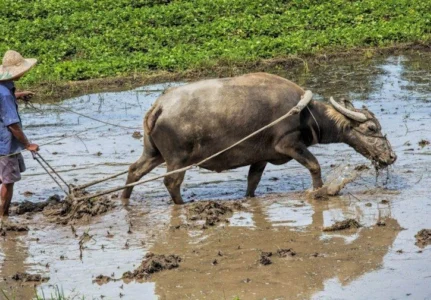
Working the Rice Fields
Before tractors became widespread, buffaloes pulled wooden plows through muddy paddies, turning the soil in preparation for planting. Their broad hooves and powerful bodies make them well suited to wet agricultural landscapes.

Grazing & Daily Care
Buffaloes feed mainly on grasses and other vegetation, including rice straw. Farmers provide grazing areas, drinking water, shelter, and opportunities to cool down, especially during Vietnam's hot season.

An Asset for Farming Families
Traditionally, owning a buffalo represented an important household investment. Beyond agricultural labor, buffaloes could provide manure for fertilizing fields and serve as valuable livestock for rural families.

Tradition Meets Modern Farming
Today, tractors and mechanical tillers perform much of the work once done by buffaloes. Nevertheless, animal-powered farming survives in some communities, preserving skills passed down through generations.
LIFE THROUGH THE SEASONS
The Rhythm of Nature
Following the Rice-Growing Cycle
The water buffalo's traditional working life has been closely connected to the agricultural calendar. As rice fields change from muddy paddies to green shoots and golden harvests, the buffalo's role changes too.
The following sequence illustrates a traditional rice-growing cycle. Actual seasons and farming methods vary across Vietnam.
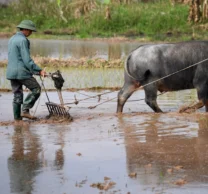
STAGE 1
Preparing the Fields
Before planting, farmers traditionally guided buffaloes through flooded paddies to plow and loosen the soil. This helped prepare the land for the next rice crop.

STAGE 2
Planting the Rice
Once the fields are prepared, young rice seedlings are transplanted or seeds are sown. Buffaloes are kept away from vulnerable new crops.
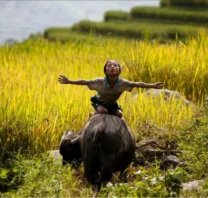
STAGE 3
Growing Season
As the rice grows, buffaloes may graze on nearby grassland or rest in shaded areas. Their daily care continues even when they are not working.

STAGE 4
Harvest & Renewal
When the rice turns golden, farmers gather the crop. Traditionally, buffaloes could also help transport loads, while rice straw and post-harvest vegetation provided useful feed.
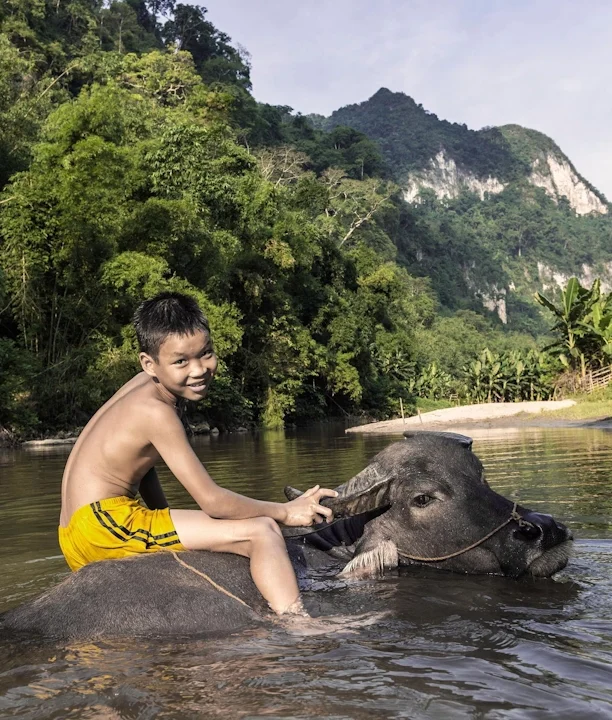
CULTURE & TRADITIONS
Beyond the Landscape
More Than a Farming Animal
Beyond its practical importance, the water buffalo occupies a special place in Vietnamese culture. It appears in traditional paintings, popular sayings, childhood memories, and village celebrations, representing the close relationship between people and the land.
Buffaloes in Traditional Festivals
The Đồ Sơn Buffalo Fighting Festival in Hải Phòng is a longstanding local tradition associated with community identity and spiritual beliefs.
Its ceremonies reflect the historical importance of buffaloes in local culture. However, the fighting itself raises significant animal-welfare concerns, and visitors should consider these issues when learning about the tradition.


The Buffalo in Vietnamese Folk Art
In the traditional Đông Hồ paintings of northern Vietnam, buffaloes often appear alongside young children, lotus flowers, and peaceful countryside scenes. One famous motif depicts a child playing a flute while riding a buffalo.
These colorful woodblock prints celebrate the simplicity and harmony of rural life. Today, they remain an important expression of Vietnamese folk-art heritage.
“Con trâu là đầu cơ nghiệp.”
“The buffalo is the foundation of a farmer's livelihood.”
This traditional saying reflects a time when owning a buffalo was essential to establishing a prosperous farming household.
EXPLORE RURAL VIETNAM
Where to Discover It
Meet the Water Buffalo in Its Natural Landscape
From northern mountain valleys to the waterways of the Mekong Delta, Vietnam offers beautiful opportunities to observe buffaloes in rural settings. These destinations combine striking scenery with glimpses of traditional agricultural life.

Pù Luông
THANH HÓA PROVINCE
Terraced rice fields, traditional villages, and mountain scenery make Pù Luông a beautiful place to experience northern Vietnam's rural landscapes. Buffaloes may be seen grazing near fields and village paths.
Best time: May–June or September–October for scenic rice fields.

Ninh Bình
NORTHERN VIETNAM
Famous for limestone mountains and peaceful waterways, Ninh Bình offers picturesque rural roads and rice paddies. Buffaloes can occasionally be spotted in agricultural areas beyond the busiest tourist attractions.
Best time: May–June for golden rice landscapes; buffalo sightings vary.

Mekong Delta
SOUTHERN VIETNAM
Across the delta's vast agricultural landscapes, water buffaloes remain part of rural life in some communities. Exploring smaller roads and farming villages provides a quieter perspective on the region beyond its floating markets.
Best time: Year-round, depending on local weather and agricultural activity.
FASCINATING FACTS
Did You Know?
Four Surprising Facts About Water Buffaloes
Natural Swimmers
Water buffaloes are capable swimmers. Their affinity for water helps them navigate wetland environments and cool down in hot climates.
Why They Love Mud
Compared with many other cattle, buffaloes have relatively sparse sweat glands. Wallowing in mud or water helps regulate body temperature and offers some protection against biting insects.
The Secret Behind Mozzarella
Traditional mozzarella di bufala from Italy is made using milk from water buffaloes — relatives of the animals found in Vietnam's countryside.
A Symbol of the SEA Games
A cheerful golden buffalo named Trâu Vàng was the official mascot of the 22nd Southeast Asian Games, hosted by Vietnam in 2003.
SHARE YOUR JOURNEY
CHANGE THE WAY WE ENJOY